I honestly don’t know if I’d call it a conspiracy theory, but I do believe we’re often distracted by the noise of the world so we don’t focus on what matters most. The enemy doesn’t always attack with chaos—sometimes he simply keeps us so busy, overwhelmed, entertained, and consumed by the next thing that we slowly drift away from the things that truly matter.
The more I grow in my faith, the more I realize that our greatest battle isn’t always what’s happening around us… it’s what quietly steals our attention, our peace, and our time with God. If the enemy can’t destroy us, he’ll often settle for distracting us. And sometimes, the most dangerous distractions don’t even look bad—they just keep us from the best.
So here’s my question… What is one distraction in your life that may be quietly pulling you away from the person God is calling you to become?
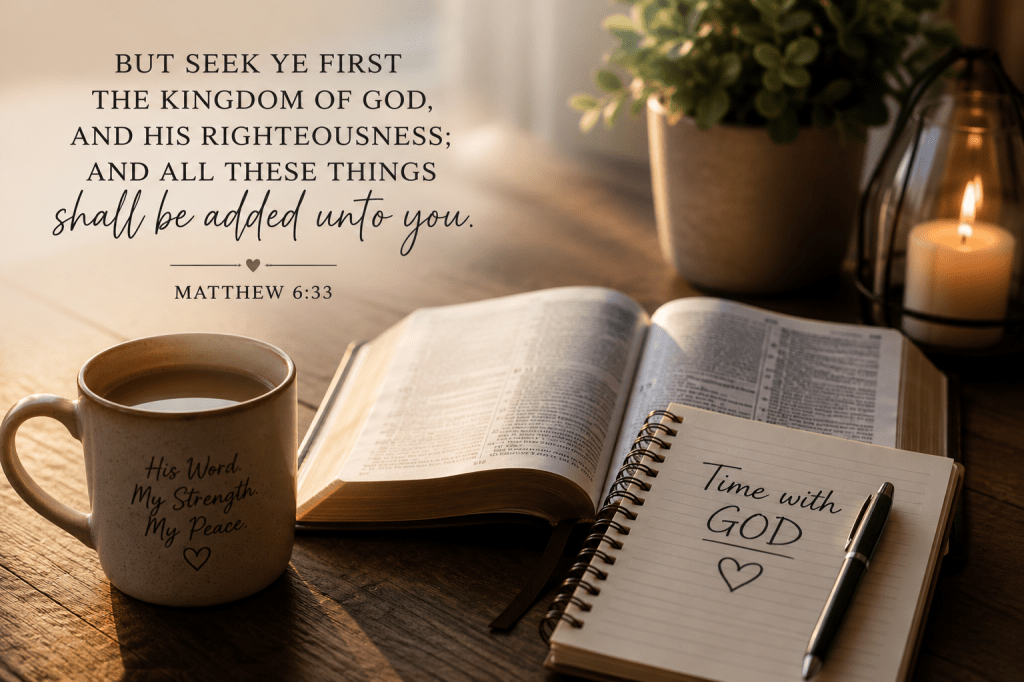
“But seek ye first the kingdom of God, and his righteousness; and all these things shall be added unto you.” — Matthew 6:33
There is something beautiful about this verse because Jesus doesn’t tell us to fit Him into the empty spaces of our lives.
He tells us to seek Him first.
Every evening, my youngest daughter sits down to do her homework.
This year she started fifth grade and was blessed with some pretty awesome teachers. One of the reasons they’re so awesome is because they’re passionate about what they do. They want their students to learn, grow, and succeed.
Along with great teachers comes something my daughter isn’t quite as excited about…
Homework.
Every night she has to read twenty pages from the book she’s currently reading.
With school only being back in session for a week, she’s still very much in summer mode. Almost every night I hear the same thing.
“Do I have to read all twenty pages?”
“I’m so tired.”
“I don’t want to read tonight.”
As her mom, my response is always the same.
“Yes, you do. It’s your homework. Reading is good for you, and it’s not optional.”
Then, in one of those moments that only God can orchestrate, He quietly spoke to my heart.
“What about you?”
For a second, I didn’t know how to answer.
Then, almost instinctively, I started giving God the very same excuses my daughter had just given me.
“I’ve been so busy.”
“The kids…”
“Work…”
“Sports…”
“Dinner…”
“The dishes…”
“The laundry…”
“I’ve been getting up at 5:45 every morning and going to bed late.”
Before I could justify myself any further, it was as if God gently responded with the very words I had just spoken to my daughter.
“It’s homework. It’s not optional. My Word is good for you.”
Ouch.
If that wasn’t a loving conviction, I don’t know what was.
How often do we faithfully complete everything the world requires of us while neglecting the one thing our souls need most?
We show up for work.
We get the kids where they need to be.
We wash the laundry.
We cook the meals.
We answer the emails.
We keep the house running.
We make sure everyone else fulfills their responsibilities.
Yet when it comes to spending time with God, somehow it’s the first thing we convince ourselves can wait until tomorrow.
The truth is, if my daughter skipped her homework every night because she was tired, eventually it would affect her growth.
The same is true for us.
We can’t expect to grow spiritually if we continually skip the very thing God uses to grow us.
The difference is that my daughter has me.
She has someone who reminds her.
Encourages her.
Holds her accountable.
As adults, no teacher is collecting our Bible reading the next morning.
No one is checking whether we spent time with the Lord before the day began.
That kind of accountability has to come from within.
Life is busy.
Our calendars are full.
By the end of the day, we’re running on fumes.
But maybe that’s exactly why God asks us to come to Him.
Not because He needs our time…
Because we need Him.
The beautiful thing is that God isn’t asking for perfection.
He isn’t waiting for the laundry to be folded, the dishes to be washed, or the house to be quiet before He invites us into His presence.
He simply asks us to come.
Sometimes it’s twenty minutes.
Sometimes it’s ten.
Sometimes it’s one chapter before the day begins.
Sometimes it’s a whispered prayer while folding laundry.
But whatever it looks like, it shouldn’t become the leftover part of our day.
It should become the foundation of it.
As parents, we lovingly teach our children that some things are too important to skip, even when they’re tired.
Maybe it’s time we start holding ourselves to that same standard.
Because God’s Word isn’t another task to check off our list.
It’s the very thing that gives us the strength, wisdom, and peace to face everything else on it.
So tomorrow morning, before you check your email…
Before you start the laundry…
Before you tackle the endless to-do list…
Remember what God so gently reminded me.
It’s homework.
It’s not optional.
🎵 Worship that encouraged me this week: “First Things First” by Consumed By Fire. Sometimes I need the reminder that before the laundry, before the emails, before the endless to-do list… God simply asks for my heart first.
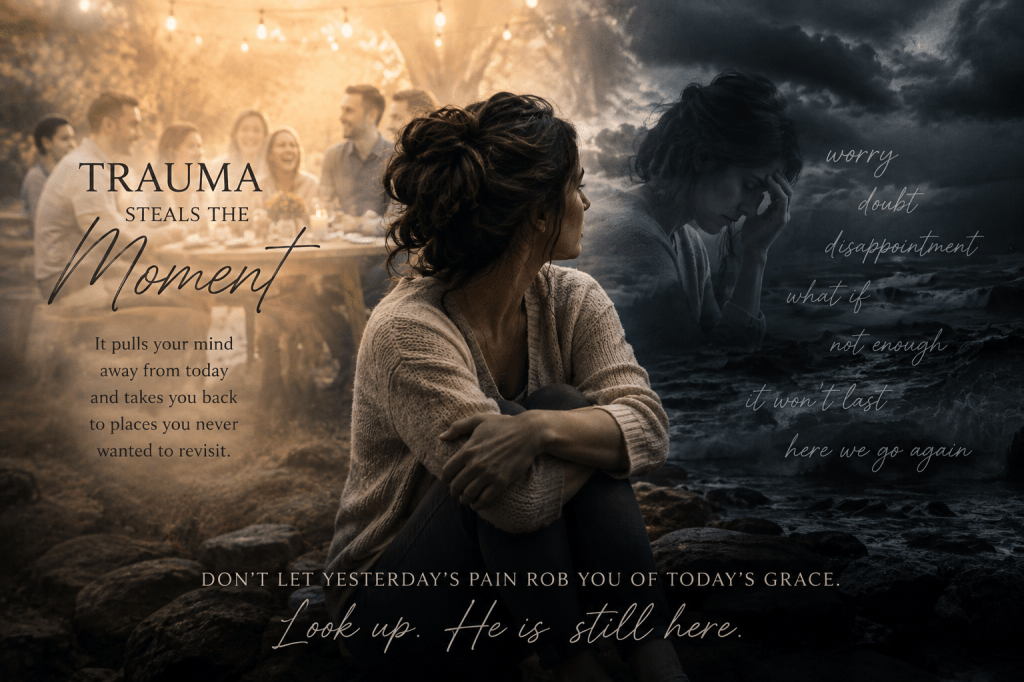
One of the hardest things about trauma is that it doesn’t ask permission before it interrupts your life.
You can be surrounded by the people you love.
Sitting at dinner with your family.
Laughing with friends.
Worshipping at church.
Watching your child do something that should fill your heart with joy.
Everything around you says, “Be present.”
But your mind quietly slips somewhere else.
Without warning, you’re no longer fully in the room.
You’re back in the place where trust was broken.
Where disappointment lives.
Where the unanswered questions still echo.
Where your heart learned to prepare for the worst before it ever had the chance to enjoy the best.
Trauma has a way of convincing your mind that if it stays alert, it can somehow protect you from being hurt again.
So while everyone else is enjoying the moment, your thoughts begin racing.
What if something happens?
What if this doesn’t last?
What if I’m missing something?
What if the peace I feel right now disappears tomorrow?
And before you even realize what’s happening, fear has quietly stolen the very moment you were longing to enjoy.
That is what trauma does.
It doesn’t always scream.
Sometimes it whispers.
It quietly pulls your attention away from the people sitting right in front of you and redirects it toward worries that don’t even exist yet.
It steals laughter before it has the chance to become joy.
It replaces peace with vigilance.
It convinces you that if you let your guard down, you’ll somehow be caught off guard again.
Even on the days when your soul finally feels calm…
when you wake up lighter…
when you begin to believe healing is happening…
it can feel as though a wave suddenly crashes over you.
A memory.
A feeling.
A smell.
A thought.
A disappointment you didn’t see coming.
And suddenly you’re underwater again.
Not because you chose to go there.
But because trauma remembered before you did.
I’ve learned that healing isn’t the absence of those waves.
Healing is recognizing that they no longer define where I live.
They still come.
But they don’t get to stay.
The wave may crash over me, but it doesn’t get to carry me away.
Because there is One who walks on the very waters that once convinced me I was drowning.
When Peter took his eyes off Jesus, the waves became bigger than the One who had called him out of the boat.
How often do we do the same?
We become so focused on the waves of yesterday that we miss the presence of the Savior standing with us today.
Jesus never promised that the storm would disappear.
But He did promise that He would be with us in it.
Maybe today the enemy isn’t trying to steal your future.
Maybe he’s trying to steal this moment.
The laughter you’re hearing.
The hug you’re receiving.
The worship filling the room.
The smile on your child’s face.
The peace God has graciously given you today.
Don’t let yesterday’s pain rob you of today’s grace.
And when you feel your mind drifting back into places you never wanted to revisit, gently bring it back to the One who is already waiting for you there.
“Thou wilt keep him in perfect peace, whose mind is stayed on thee: because he trusteth in thee.” — Isaiah 26:3
Perfect peace doesn’t come because our minds never wander.
It comes because every time they do, we know where to bring them back.
Back to Jesus.
Back to truth.
Back to the present.
Back to the grace that is waiting for us in this very moment.
But I’ve learned there is a kind of exhaustion that sleep can’t touch.
It’s the exhaustion that comes from never allowing your mind to fully let go.
If you’re married to someone battling PTSD and addiction, you probably know exactly what I’m talking about.
Your body may be sitting on the couch, but your mind is somewhere else.
It’s wondering if what you’re being told is the whole truth.
It’s replaying yesterday’s conversation, trying to figure out if you missed something.
It’s noticing little changes in behavior that no one else would ever see.
It’s preparing for the next disappointment before this one has even had time to heal.
You don’t even realize you’re doing it anymore.
It has simply become the way you survive.
I don’t think people understand how loud it is inside our minds.
On the outside, we smile.
We go to work.
We cook dinner.
We laugh with our children.
We sit beside our husbands at church.
We answer, “I’m good,” when someone asks how we’re doing.
But inside… our minds never stop searching for solid ground.
I can’t remember the last time I completely relaxed.
Not because I don’t want to.
Because I don’t know how.
When your heart has been blindsided enough times, it begins to believe that if it stays alert, maybe it can prevent the next heartbreak.
So we stay busy.
We keep cleaning.
We keep organizing.
We keep serving everyone around us.
We keep thinking.
Constantly thinking.
Because slowing down means feeling.
And feeling means touching the grief we’ve spent so much energy trying to hold together.
What I’ve realized is that I haven’t just been carrying my own pain.
I’ve been carrying his too.
His PTSD.
His addiction.
His shame.
His recovery.
His choices.
His consequences.
As if somehow, if I could carry enough of it, maybe he wouldn’t have to.
Maybe then he’d finally have enough strength to get better.
But somewhere along the way, I quietly became exhausted from carrying a burden that was never mine to carry.
Maybe you have too.
Maybe that’s why you’re so tired.
Not because you’re weak.
Not because you’re doing life wrong.
But because you’ve been trying to hold together things that only God can hold.
I wish I could tell you I’ve learned how to quiet my mind.
I haven’t.
There are still nights when my thoughts race faster than I can pray.
There are still days when one unanswered question steals my peace.
There are still moments when I catch myself looking for evidence that everything is okay instead of simply living.
But I’ve discovered something beautiful.
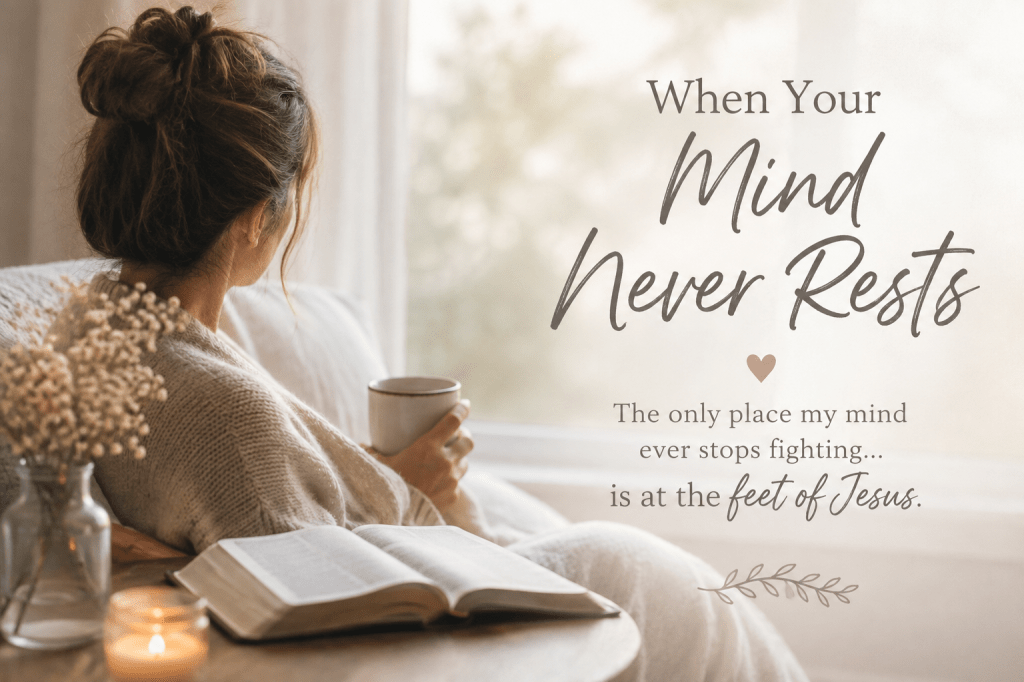
The only place my mind ever stops fighting… is at the feet of Jesus.
Not because my circumstances suddenly change.
Not because the addiction disappears.
Not because tomorrow suddenly feels certain.
But because His presence reminds me that I was never asked to carry tomorrow.
I was only asked to trust Him with today.
There are moments when I open my Bible with tears already filling my eyes, and before I even finish reading, I can almost feel my soul exhale.
For just a moment, the fear grows quieter.
The “what ifs” loosen their grip.
The constant pressure to figure everything out fades into the background.
Nothing around me has changed.
But something inside me has.
Not because I became stronger.
Because I remembered who was carrying me.
Maybe that’s what our souls have been searching for all along.
Not another answer.
Not another promise from the person we love.
Not another guarantee that everything will finally be okay.
Maybe we’ve simply been longing for a place where our weary hearts can finally set the weight down.
Jesus knew there would be people like us.
People who would become weary from carrying burdens they were never meant to carry alone.
That is why His invitation still reaches into my heart every single time I read it:
“Come unto me, all ye that labour and are heavy laden, and I will give you rest.” — Matthew 11:28
Lately, when the noise in my mind becomes too loud, I’ve found myself playing “Quiet (Stripped)” by Maverick City Music.
There is something about those simple lyrics that reminds me of what my heart has been longing for all along—not answers, not certainty, just the quiet peace that only God’s presence can bring.
Maybe that’s why I keep coming back to Jesus.
Not because everything is okay.
But because when my mind refuses to rest, He gently reminds my soul that it can.
If your heart is weary today, I pray you’ll find a quiet place, open His Word, press play, and simply sit with Him for a while.
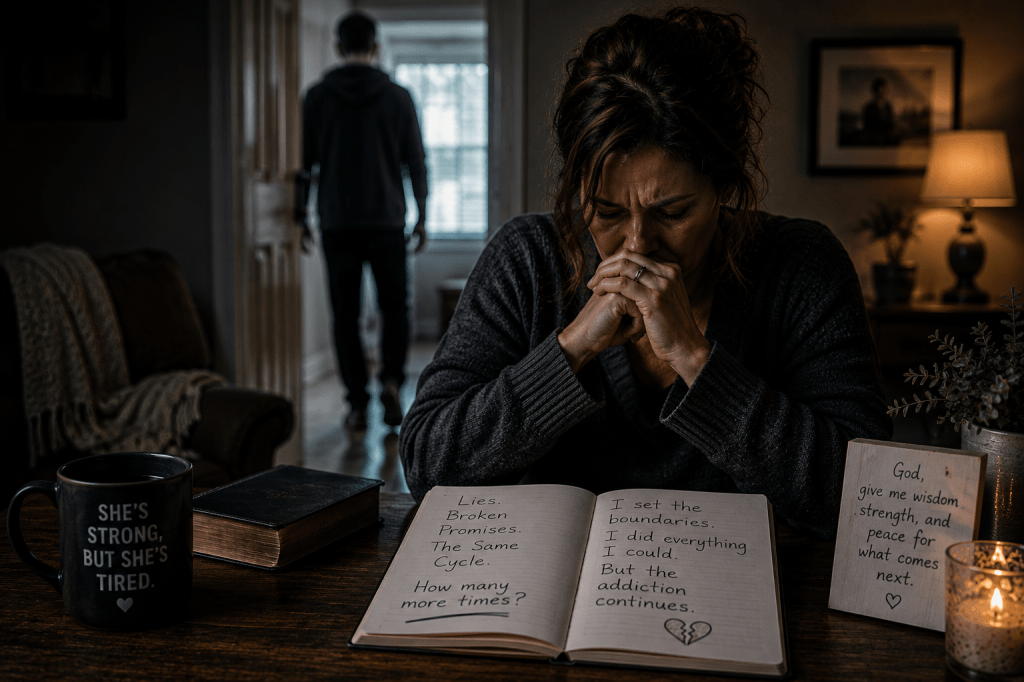
I have taken full control of them because addiction made it necessary.
We’ve done rehab.
We’ve done therapy.
We’ve involved family.
We’ve brought other people into the situation for accountability.
We’ve had the conversations.
We’ve cried.
We’ve prayed.
We’ve made plans.
We’ve talked about consequences.
We’ve had promises made after painful discoveries.
We’ve tried things that were supposed to help.
And still…
the addiction continues.
The lies continue.
That’s the part I’m struggling to understand now.
Because eventually you run out of smaller boundaries.
There comes a point where you’ve already moved the money. You’ve already created accountability. You’ve already encouraged treatment. You’ve already stopped hiding everything from the people closest to you.
And you’re still standing there looking at the same behavior.
So what boundary comes next?
That question terrifies me.
When You’ve Done Everything Except Leave
Maybe that’s the part I haven’t wanted to say out loud.
What happens when you’ve done almost everything you know to do except physically remove yourself from the cycle?
That’s a much harder question than, “How do I set a boundary?”
Because I know how to set boundaries now.
I know how to protect the finances.
I know how to say no.
I know how to involve other people.
I know how to encourage treatment.
I know how to recognize manipulation much faster than I used to.
What I don’t always know is what to do when none of it changes the person I love.
There is a painful realization that comes with that:
Maybe the purpose of my boundaries was never to make him change.
I think somewhere inside me, I still believed they would.
If I controlled the finances, maybe the gambling would stop.
If enough people knew, maybe the accountability would stop the lying.
If he went to rehab, maybe he would finally understand.
If therapy uncovered the deeper issues, maybe everything would begin to change.
If he saw how close he came to losing his marriage, surely that would be enough.
But what happens when it isn’t?
What happens when every safeguard you put into place becomes another obstacle the addiction learns how to work around?
That is when boundaries stop feeling empowering and start feeling heartbreaking.
Because I am forced to confront something I desperately don’t want to be true:
I can make it harder for addiction to destroy our lives, but I cannot make another person choose recovery.
I Cannot Boundary Someone Into Recovery
That sentence hurts to write.
I cannot boundary someone into recovery.
I cannot monitor someone into honesty.
I cannot control the finances enough to create integrity.
I cannot make accountability work if someone is determined to hide.
I cannot love someone into telling the truth.
I cannot find the perfect therapist, rehabilitation center, consequence, Bible verse, conversation, or arrangement that will make someone choose something they are unwilling to choose for themselves.
And maybe that’s why this stage feels so different.
In the beginning, there was always another thing to try.
Another conversation.
Another boundary.
Another safeguard.
Another treatment.
Another chance.
Doing something made me feel like there was still something I could control.
But eventually you arrive at a place where the question isn’t:
“What else can I do to stop him?”
It becomes:
“What am I going to do if he doesn’t stop?”
And I don’t like that question nearly as much.
Because that question is about me.
The Apology Doesn’t Fix It Anymore
There was a time when an apology brought relief.
Maybe this time he understood.
Maybe this was rock bottom.
Maybe losing this much would finally be enough.
Maybe seeing me this broken would finally make something click.
But after enough cycles, apologies begin to feel different.
You want to believe them.
Part of you still does.
But another part of you is quietly keeping track of everything that came before.
You remember the other apologies.
The other promises.
The other “last times.”
The other moments when you thought the nightmare was finally ending.
So you’re standing there listening to someone say they’re sorry while two completely different voices are fighting inside you.
One says:
Give him grace.
People mess up.
Addiction is hard.
Marriage means fighting for each other.
God can still restore this.
And the other says:
We’ve been here before.
That second voice used to make me feel guilty.
Now I’m beginning to wonder if that voice isn’t bitterness at all.
Maybe it’s discernment.
Maybe wisdom sometimes remembers the pattern even when your heart desperately wants to believe the promise.
When Hope Starts Keeping You Stuck
This is difficult for me to admit because hope sounds like such a beautiful Christian word.
And it is.
I believe in hope.
I believe God changes people.
I believe marriages can be restored.
I believe addicts can recover.
I believe broken things can become beautiful again.
But I’m beginning to understand that hoping someone changes and living as though they already have are two very different things.
I can hope for recovery without pretending recovery is happening.
I can pray for honesty while acknowledging that I’m still being lied to.
I can believe God can restore my marriage without calling the current situation restored.
Maybe faith isn’t denying what is happening because I’m afraid of what acknowledging it might require me to do.
Maybe faith is trusting God enough to tell the truth about what is happening.
This Is Where Avoidance Gets Really Uncomfortable
Because when all the smaller boundaries have already been put into place, there aren’t many comfortable options left.
That’s when my avoidant side wants to bargain.
Maybe give it a little more time.
Maybe this apology is different.
Maybe therapy will eventually click.
Maybe I need to be more understanding.
Maybe I’m expecting too much too quickly.
Maybe I should just be thankful for the good days.
Some of those thoughts may occasionally contain truth.
Recovery isn’t perfect.
People do stumble.
Change takes time.
But there is also a difference between an imperfect recovery and an ongoing pattern of addiction, deception, and manipulation without sustained change.
I have to be careful that compassion doesn’t become the excuse I use to avoid making a decision.
Because eventually, “give it more time” can become years.
The Boundary I’m Afraid Of
Maybe this is where I am learning that the hardest boundary isn’t controlling money.
It isn’t demanding treatment.
It isn’t telling family.
It isn’t even saying, “I won’t tolerate this anymore.”
The hardest boundary may be accepting what I will have to do if nothing changes.
I don’t write that lightly.
I don’t believe marriage should be discarded because things become difficult.
I don’t believe struggling with addiction makes someone unworthy of love.
And I certainly don’t believe every wife reading this should make the same decision.
But I also no longer believe that loving someone requires me to endlessly absorb the consequences of choices I cannot control.
There is a point where I have to stop asking:
“What else can I do to make him change?”
and start asking:
“God, what are You asking me to do if he chooses not to?”
That prayer scares me.
Because I have spent so much time praying for God to change him.
Maybe now I also need the courage to ask God to show me what obedience looks like for me.
Maybe Boundaries Were Never About Saving My Marriage
I wanted boundaries to save my marriage.
I wanted treatment to save it.
I wanted accountability to save it.
I wanted controlling the finances to save it.
I wanted therapy to save it.
I wanted love, patience, forgiveness, prayer, consequences, and second chances to eventually add up to transformation.
But none of those things can substitute for another person’s willingness to change.
Maybe boundaries aren’t how I save my marriage.
Maybe boundaries are how I stop losing myself while I wait to see what the other person chooses.
And maybe that is what I am finally beginning to understand.
I can love him.
I can pray for him.
I can forgive him.
I can hope for him.
I can believe with everything inside me that God is capable of completely transforming his life.
And I can still tell the truth about what is happening right now.
The addiction continues.
The lies continue.
The boundaries haven’t produced the change I hoped they would.
And I cannot keep pretending that an apology is the same thing as recovery.
Maybe the next step isn’t another rule for him.
Maybe it’s finally asking God what He wants from me when I have done everything I know to do—and the person I love still chooses the addiction.
I don’t have a neat answer to that yet.
Maybe that’s okay.
Maybe understanding myself begins with finally being willing to ask the question.
Trust is one of the most sacred gifts exchanged within a covenant marriage. It isn’t built overnight, and it isn’t sustained by words alone. It is earned through consistency, honesty, sacrifice, and love. When a husband and wife give themselves fully to one another, they create a place of refuge—a relationship where both feel safe to be vulnerable, truly seen, deeply heard, and completely accepted.
This is God’s design.
Marriage was never meant to be a battlefield where lies, deception, manipulation, and betrayal slowly replace intimacy. It was created to be a holy covenant where two people become one, with Christ at the center. When both husband and wife continually pursue God, they naturally grow closer to each other. There is little room for the enemy to gain a foothold because every part of the marriage is surrendered to the One who holds it together.
But when deception enters, everything begins to change.
Trust, once broken, leaves a wound that cannot simply be ignored. Even when healing comes, scars often remain. Those scars don’t mean restoration is impossible, but they do remind us that something sacred was violated. What God intended to be a place of security becomes a place of uncertainty.
Repeated deception doesn’t just damage a marriage—it slowly damages the heart of the one living through it.
Over time, constant lies and manipulation begin to rot you from the inside out. You start questioning everything. You question your memories. You question your instincts. You question your worth. You wonder if you’re asking for too much or expecting too much. You replay conversations in your mind, searching for what was real and what wasn’t.
Eventually, you begin questioning your identity.
The confidence you once carried slowly fades beneath the weight of broken promises and shattered expectations. You stop recognizing the person staring back at you in the mirror because you’ve spent so long trying to survive someone else’s choices. The emotional exhaustion becomes overwhelming. You feel lonely even when you’re sitting beside the person you married. You feel unseen, unheard, unloved, and abandoned by the one who once promised to protect your heart.
That is what betrayal does.
It doesn’t just break trust—it fractures the very foundation you believed your life was built upon.
Yet even here, God meets us.
While people can shatter our trust, they cannot steal our identity unless we allow them to define it. Our value has never been determined by someone else’s faithfulness but by God’s unchanging love for us. He sees every hidden tear, every sleepless night, every moment spent wondering if things will ever be different.
Psalm 34:18 reminds us:
“The Lord is near to the brokenhearted and saves those who are crushed in spirit.”
If you are living with the wounds of betrayal, know this: your pain is real, and your scars are not invisible to God. He understands the grief of broken covenant because He, too, has experienced the unfaithfulness of those He loves. Yet He is still in the business of restoring what sin has broken.
Healing may not erase the scars, but God has a beautiful way of transforming scars into testimonies of His faithfulness.
Your trust may have been shattered by a person, but it can be rebuilt through the One who has never broken a single promise.
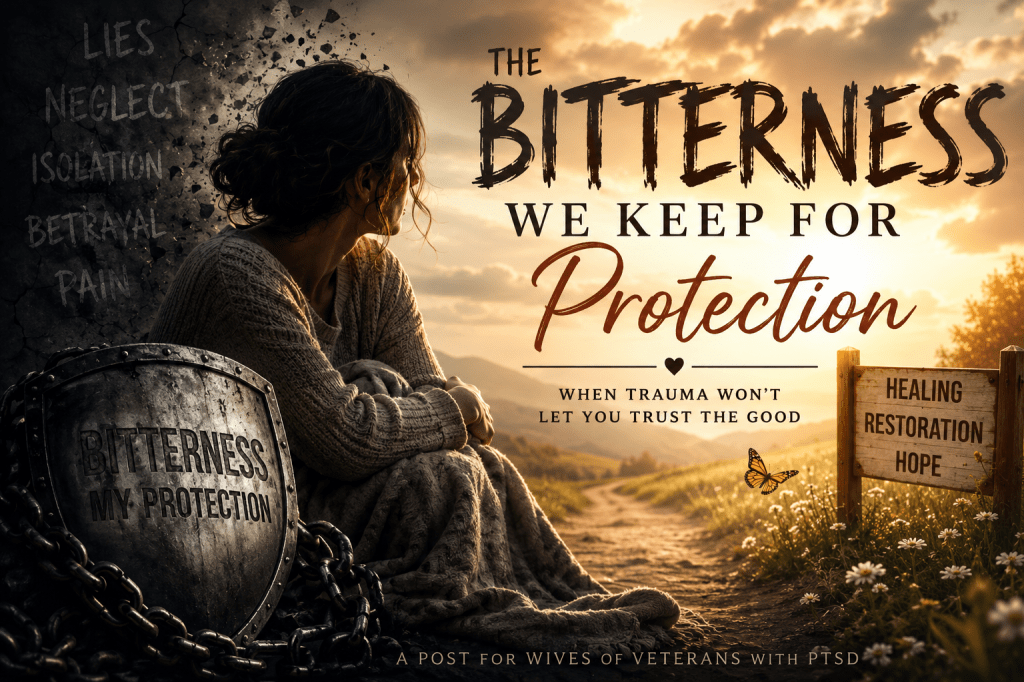
It’s difficult not to carry bitterness after years of lies, isolation, disappointment, and neglect. Even when progress finally begins to happen—when you start to see the changes you’ve prayed for over countless sleepless nights—your trauma-fogged mind doesn’t immediately celebrate. Instead, it whispers, What if this doesn’t last? What if this all falls apart again?
Before long, those whispers become screams. Don’t trust it. Don’t believe it. You’re going to suffer again.
It’s a fight-or-flight response that every wife living alongside PTSD understands. It’s that familiar feeling of being pulled back into the darkness just when you thought you had finally found your footing. You try so hard to climb out of the hole, only to find yourself peering back over the edge, waiting for the ground to give way beneath you again.
The truth is, that kind of bitterness doesn’t simply disappear when happiness or healing begins to emerge. It lingers quietly in the background, like a shadow waiting for the perfect opportunity to remind you why you built walls around your heart in the first place. It waits for one bad day, one harsh word, one familiar pattern, hoping to convince you that nothing has really changed after all.
Because when you’ve lived in survival mode for so long, joy itself can feel unsafe.
At the end of the day, the feelings of happiness, romance, love, being wanted, being needed, and finally being seen can sometimes feel like a mask you’re simply waiting to slip off. You’re bracing yourself for the moment when the only reality you’ve ever truly known comes rushing back. The bitterness you’ve held onto wasn’t always hatred—it was protection. It was armor. It was the emergency plan you kept hidden away because some part of you refused to trust that restoration could actually be real.
Trauma leaves wounds that do not always bleed where others can see them. They remain open beneath the surface, quietly whispering that you’ll never be enough, that you’re not safe, and that hope is dangerous.
But perhaps the greatest act of faith isn’t pretending those wounds don’t exist. Perhaps it’s choosing, one day at a time, to believe that God can heal the places we’ve spent years trying to protect ourselves from feeling.
It doesn’t magically get easier with time. In fact, if we’re honest, the longer we’re married, the more opportunities we have to hurt one another, disappoint one another, and drift apart.
One thing I know for sure is that the enemy will do everything in his power to destroy what God intended to be sacred.
But what if the answer isn’t always walking away?
What if some marriages could be saved by going through the divorce before the divorce?
Before you stop reading, hear me out.
I’m not talking about ending your marriage. I’m talking about ending the unhealthy patterns, expectations, habits, attitudes, and idols that have slowly crept into the relationship and taken God’s rightful place.
The Bible tells us in Revelation that we are to return to our “first love.” While this passage was written to the church in Ephesus, the principle is powerful for us today. God was calling His people back to the passion, devotion, and intimacy they once had with Him.
Could it be that some struggling marriages need the same thing?
Not a divorce from each other, but a divorce from everything that has pulled them away from God.
The Drift Happens Slowly
Most marriages don’t fall apart overnight.
It happens one small compromise at a time.
Communication becomes less intentional.
Life becomes busier.
Resentments go unresolved.
Expectations go unmet.
Hurts pile up.
Walls go up.
Distance grows.
Eventually, two people can find themselves living under the same roof while feeling miles apart.
The tragedy is that many couples spend years trying to change one another when the real issue is that both have drifted from the One who holds everything together.
The Bride and the Bridegroom
Throughout Scripture, God describes His relationship with His people as that of a bridegroom and a bride.
In the Old Testament, Israel was called God’s bride. In the New Testament, the Church is called the Bride of Christ.
Why?
Because God never wanted a relationship built merely on rules. He desired intimacy, devotion, faithfulness, and love.
Just as a healthy marriage suffers when spouses become disconnected, our spiritual lives suffer when we become disconnected from Christ.
When a husband and wife stop pursuing God individually, they often begin looking to one another to fulfill needs that only God can meet.
We expect our spouse to become our source of happiness.
Our peace.
Our identity.
Our security.
Our purpose.
The problem is that no human being was ever designed to carry that weight.
Only Christ can.
The Bride was never meant to live apart from the Bridegroom.
And neither were we.
Before You Give Up, Work on You
So ladies, what if instead of slowly losing yourself in the pain of a struggling marriage, you decided to invest in yourself again?
What if you started taking care of the woman God created you to be?
Not for another man.
Not for attention.
Not even primarily for your husband.
But because you are a daughter of the King and your well-being matters.
Somewhere along the way, many women become exhausted from carrying the weight of life. The demands of marriage, children, careers, ministry, caregiving, and everyday responsibilities can leave little energy for themselves.
What once came naturally becomes an afterthought.
Not just physically, but spiritually and emotionally as well.
What if instead of focusing on what your husband isn’t doing, you focused on who God is calling you to become?
What if you spent more time in prayer than replaying arguments?
What if you opened your Bible before opening social media?
What if you addressed the bitterness, disappointment, and wounds that have been building for years?
What if you started caring for your health—not out of vanity, but out of stewardship?
Go for the walk.
Join the gym.
Take care of your body.
Develop healthy habits.
Rediscover the things that bring life to your spirit.
Many women emerge from divorce stronger, healthier, more confident, and more purposeful because they finally begin investing in themselves again.
But what if that transformation didn’t have to wait until after the marriage ended?
What if healing started now?
What if growth started now?
What if becoming the woman God created you to be became part of the restoration process instead of the recovery process?
What Needs to Die?
Sometimes saving a marriage requires a death.
Not the death of the relationship.
But the death of pride.
The death of selfishness.
The death of resentment.
The death of keeping score.
The death of unrealistic expectations.
The death of believing your spouse is responsible for your happiness.
Many couples are trying to resurrect a marriage while refusing to crucify the things that are killing it.
Before God restores something, He often asks us to surrender something.
Returning to First Love
What if instead of focusing on changing your spouse, you focused on pursuing Christ?
What if both husband and wife became more concerned with their relationship with God than winning the latest argument?
What if prayer replaced criticism?
What if surrender replaced control?
What if grace replaced resentment?
What if both people became more committed to personal growth than proving they were right?
The closer we move toward Christ, the closer we naturally move toward one another.
A marriage centered on Christ doesn’t become perfect, but it becomes anchored.
And anchors matter when storms come.
Before You Walk Away
Some marriages are facing real pain.
Some are dealing with betrayal, addiction, neglect, abuse, or wounds that run deep. Every situation is unique, and some circumstances require boundaries, counseling, separation, accountability, or intervention.
But for many couples, the marriage isn’t dying because love disappeared.
It’s dying because intimacy with God disappeared.
Before filing for divorce, ask yourself a difficult question:
Have I returned to my first love?
Have I allowed God to do the work He wants to do in me?
Have I surrendered the things that may be contributing to the distance?
Because sometimes the marriage doesn’t need a funeral.
Sometimes it needs a revival.
Sometimes the path forward begins when both husband and wife lay down everything that has come between them and God.
Perhaps before God restores the marriage, He wants to restore the individuals within it.
Maybe the miracle isn’t found in changing your spouse. Maybe it begins by allowing God to change you.
In the song New Wine, the lyrics remind us, “In the crushing, in the pressing, You are making new wine.” New wine isn’t poured from an old vessel. God often does His deepest work in the places that feel broken, surrendered, and stretched beyond comfort.
What if this difficult season isn’t just about saving your marriage? What if God is using it to make you into a new vessel—one that is more dependent on Him, more filled with His Spirit, and more reflective of His heart?
When we allow God to do a new work within us, He can begin to pour new life, new grace, new love, and new hope into our marriages. Sometimes restoration starts not when circumstances change, but when we surrender ourselves to the Master Potter and trust Him to make something beautiful from the broken pieces.
The greatest threat to your marriage may not be your spouse.
It may be anything that has replaced Christ as the center of your heart.
Return to Him.
Pursue Him.
Let Him restore what has been broken.
After all, the Bride was never meant to live apart from the Bridegroom.
It doesn’t always come crashing through the front door. It creeps in quietly… watching… waiting… like a lion stalking its prey. And then, in a split second—it pounces.
One moment you feel steady… the next, your heart is racing, your thoughts are spiraling, and the peace you thought you had is gone. It goes from zero to one hundred without warning, stealing your joy, shaking your clarity, and making you question your own sanity. Even something as simple as breathing—in… and out—can suddenly feel overwhelming.
The more you try to trace the root of the anxiety, the deeper you spiral. Thoughts begin to stack on top of each other: I should have done this differently… Why didn’t I see this sooner… What if I’m still not doing enough… And just like that, guilt creeps in, shame follows, and the weight becomes almost unbearable. The bitterness you thought you had released returns. The resentment you prayed through resurfaces. And it all reminds you of the mess you’re still standing in.
This is the place few people understand… unless they’ve lived it.
There is a place anxiety tries to take you—a place of complete overwhelm, where your thoughts turn against you. A place that whispers, “You can’t do this… You’re too far gone… You’ll never get out of this.” That place is where self-destruction begins. Not always outwardly… but internally.
For me, that breaking point is often the very place God meets me. Not when everything is together. Not when I have the answers. But in the middle of the spiral, in the middle of the fear, in the middle of the mess. It is only by His grace that I am able to pick myself up, shake off what tried to take me down, and face life again—not because everything is fixed, but because He is sustaining me.
“God is our refuge and strength, a very present help in trouble.” — Psalms 46:1
He is not distant in your anxiety. He is present in it.
Anxiety wants to make you prey. It wants you to stay in the valley—to sit in the fear, replay the thoughts, and believe the lies. Because if it can keep you there, it can keep you stuck. But you don’t have to live there. You may walk through the valley, but you were never meant to build a home in it.
“Yea, though I walk through the valley of the shadow of death, I will fear no evil: for thou art with me…” — Psalms 23:4
If you are the woman fighting anxiety that comes out of nowhere, carrying the weight of trauma or PTSD, trying to hold everything together while silently unraveling—hear this:
You are not crazy. You are not weak. And you are not alone.
Anxiety may come like a thief, but it does not get to take everything. Because even in your lowest moment, even in your most overwhelming spiral, God is still there—steady, present, and unshaken. And when everything else feels like it’s slipping… He will be the One who holds you together.





 Life As A PTSD Wife